
The Psychology of the First Tour:What Clients Notice First
By the time a potential client steps into the first model unit, their gut decision is largely already made. The brain runs a continuous subconscious audit from the moment they pull into the parking lot, cataloguing signals, drawing comparisons, forming impressions, long before a salesperson speaks a word or a door handle is turned.
At Thoma-Holec Design, this isn't a theory. It's the foundation of how we approach every senior living community we design. Our work does not begin with furniture selections or finish boards, but with a simple question: what does this person feel the moment they arrive, and how does design answer that feeling at every single step?
For operators, investors, and development teams, understanding this psychological sequence is one of the highest-leverage concepts in senior living. Because design that wins the subconscious audit doesn't just create beautiful spaces, it accelerates lease-up, builds brand trust, and ultimately drives ROI.
First, Understand Who Is Actually on That Tour
Here's a nuance which determines everything we design: the prospective resident touring a senior living community rarely thinks of themselves as the end user — at least not yet. They're thinking, could I see my mother here? or could I see myself here in ten years?' That emotional distance creates a unique dynamic.
They're evaluating the space on behalf of someone they love, or a future version of themselves they're not fully ready to accept. Which means the design has to accomplish something remarkably difficult: it must feel safe, dignified, and genuinely aspirational — all at once.
This is why we talk internally about designing for 'the daughter/son. The adult child often drives the final decision and brings a sharp, skeptical eye. They're looking for evidence of quality and care. They're asking whether their loved ones will feel at home here, not just housed. Every design decision we make has to answer that question convincingly.
The Sequence of Subconscious Impressions
1. THE ARRIVAL EXPERIENCE — BEFORE THEY EVEN PARK
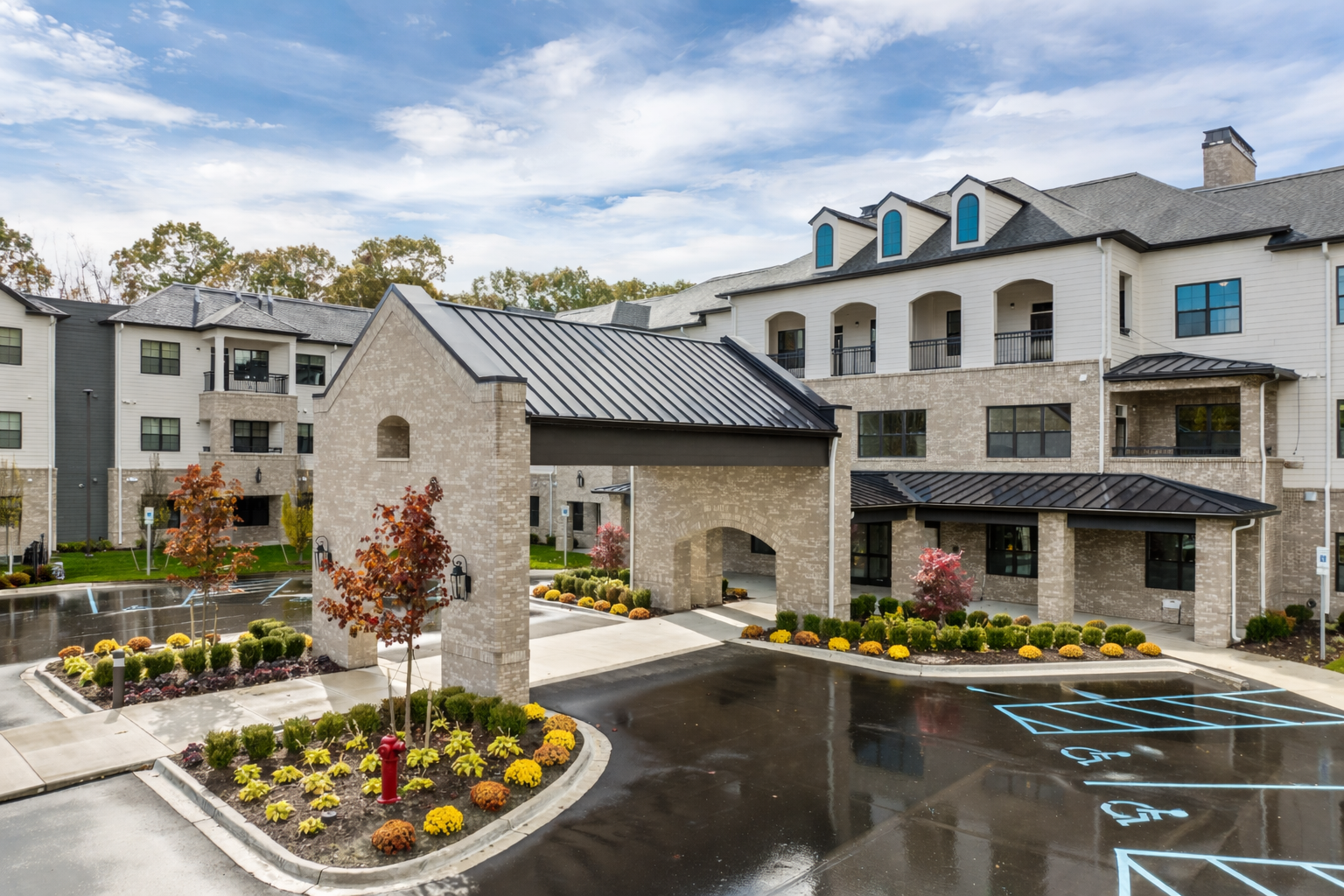
The prospective clients emotional scoring begins at the parking lot. Landscaping, exterior lighting quality, the legibility of signage, the condition of the pavement — all of it registers as a proxy for how well this community is operated and how much pride leadership takes in the asset.
While exterior design and landscaping fall outside the scope of interior design, we consider it vital to acknowledge this phase of the experience, because it sets the emotional baseline everything else builds on. When development teams, architects, landscape architects, and interior designers are aligned around a common vision for the full arrival journey, the result is a coherent story that potential residents feel from the moment they turn into the driveway. When disciplines work in isolation, that’s usually where the story starts to fall apart. The interior experience is strongest when it feels like a natural next chapter in the arrival journey, one that’s already started building trust from the very first impression.
2. THE THRESHOLD MOMENT
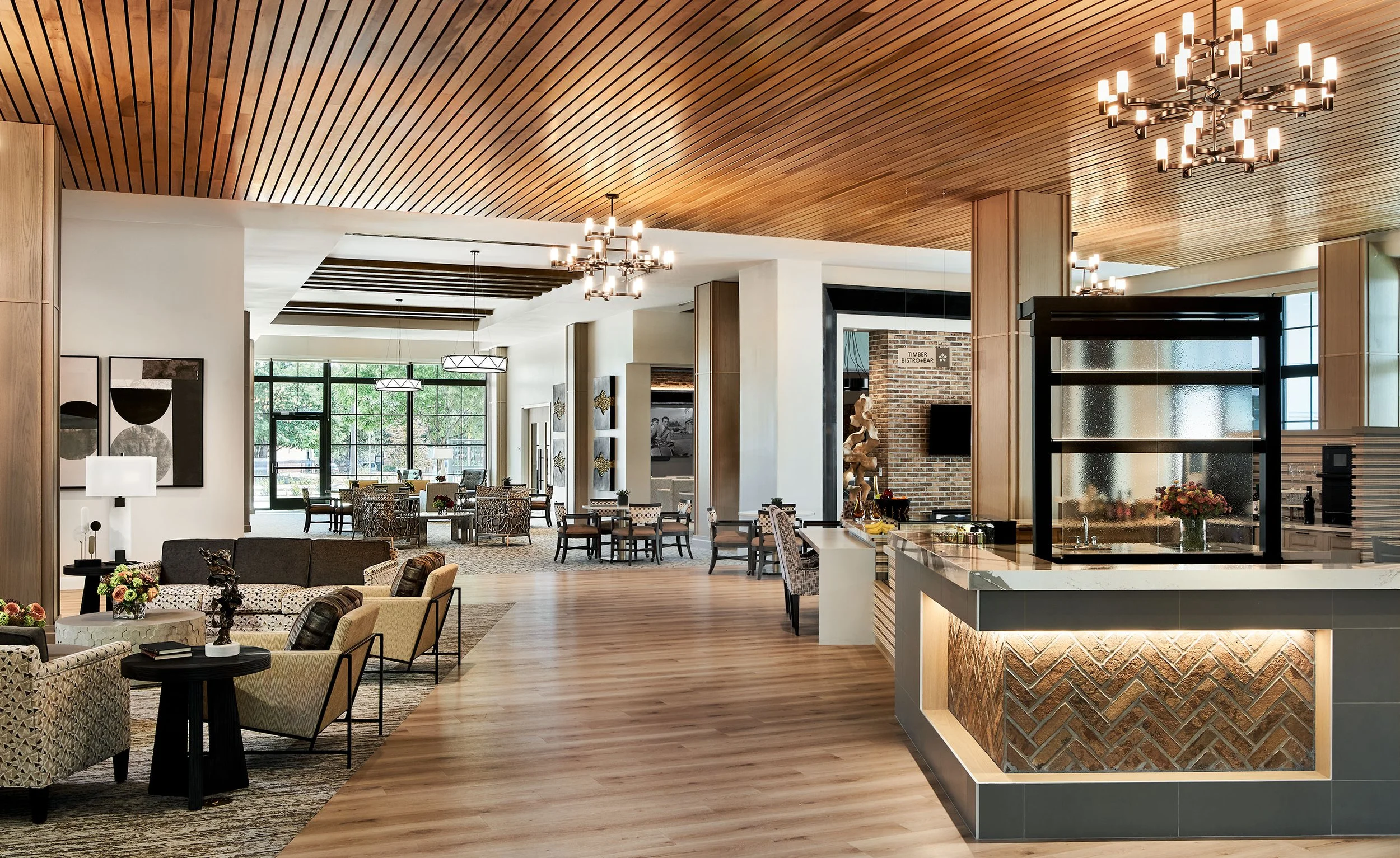
The lobby is the most psychologically loaded space in any senior living community. It answers one crucial question in the potential resident’s mind: does this feel like a home or an institution?
The signals are immediate and involuntary. Ceiling height. The quality and warmth of natural light. The smell of the space. The acoustic character, does sound absorb warmly, or does it echo off hard surfaces? The very first material a prospective client touches, a door handle, a reception desk edge — registers as a tactile signal of overall quality.
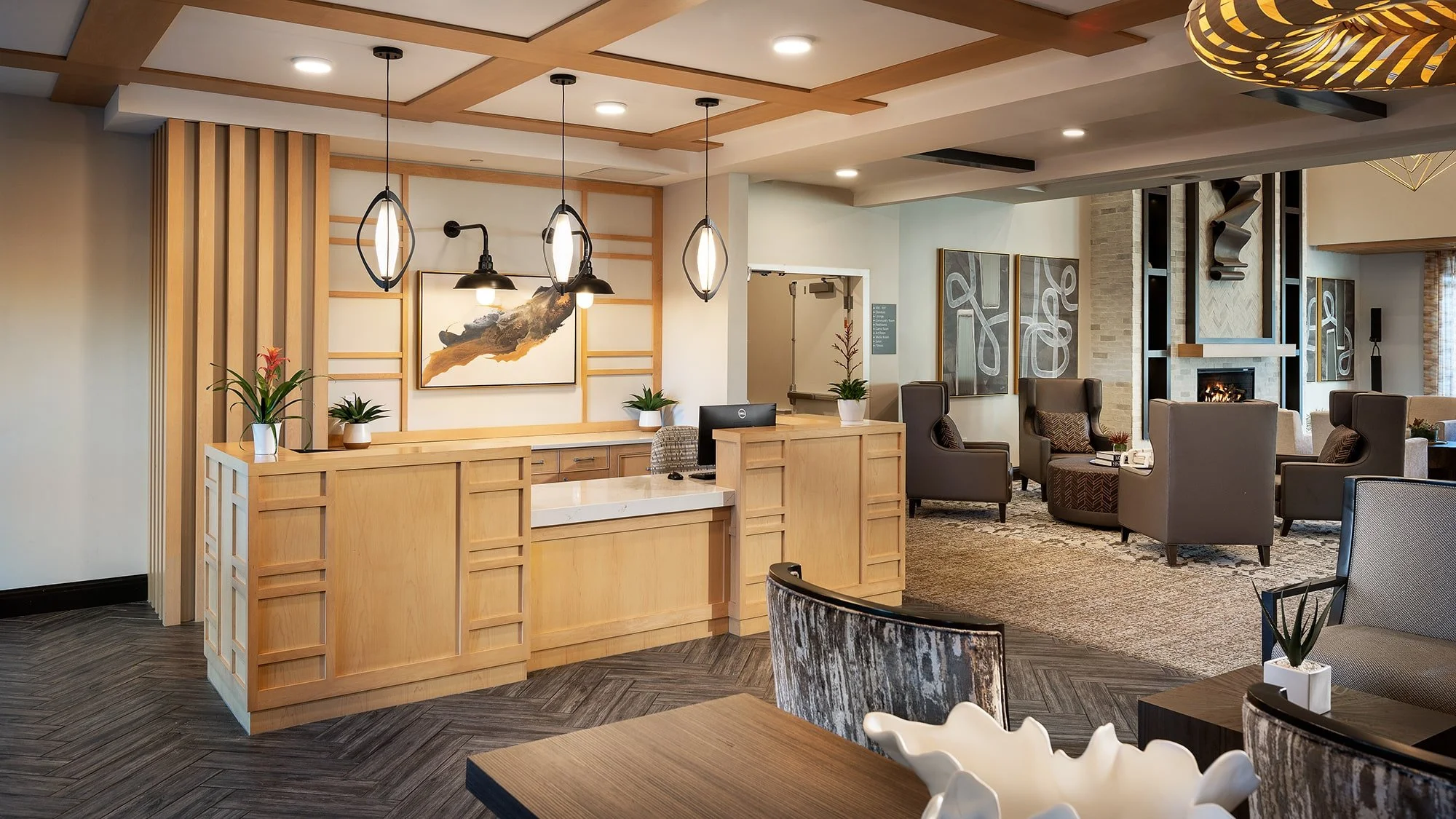
Our design philosophy holds that the lobby must work beautifully on two levels simultaneously: it has to function with precision, supporting wayfinding, staff workflows, accessibility, and daily operational realities — while also delivering an immediate emotional experience that feels nothing like a clinical or institutional setting. We draw deliberate inspiration from boutique hotels, private clubs, and high-end residential lobbies, translating the warmth and intentionality of those environments into spaces that also meet the very real functional demands of senior living. Every material, every light source, every seating arrangement is considered through both lenses, what does this do, and what does this feel like?
3. INDICATORS OF ACTIVE COMMUNITIES
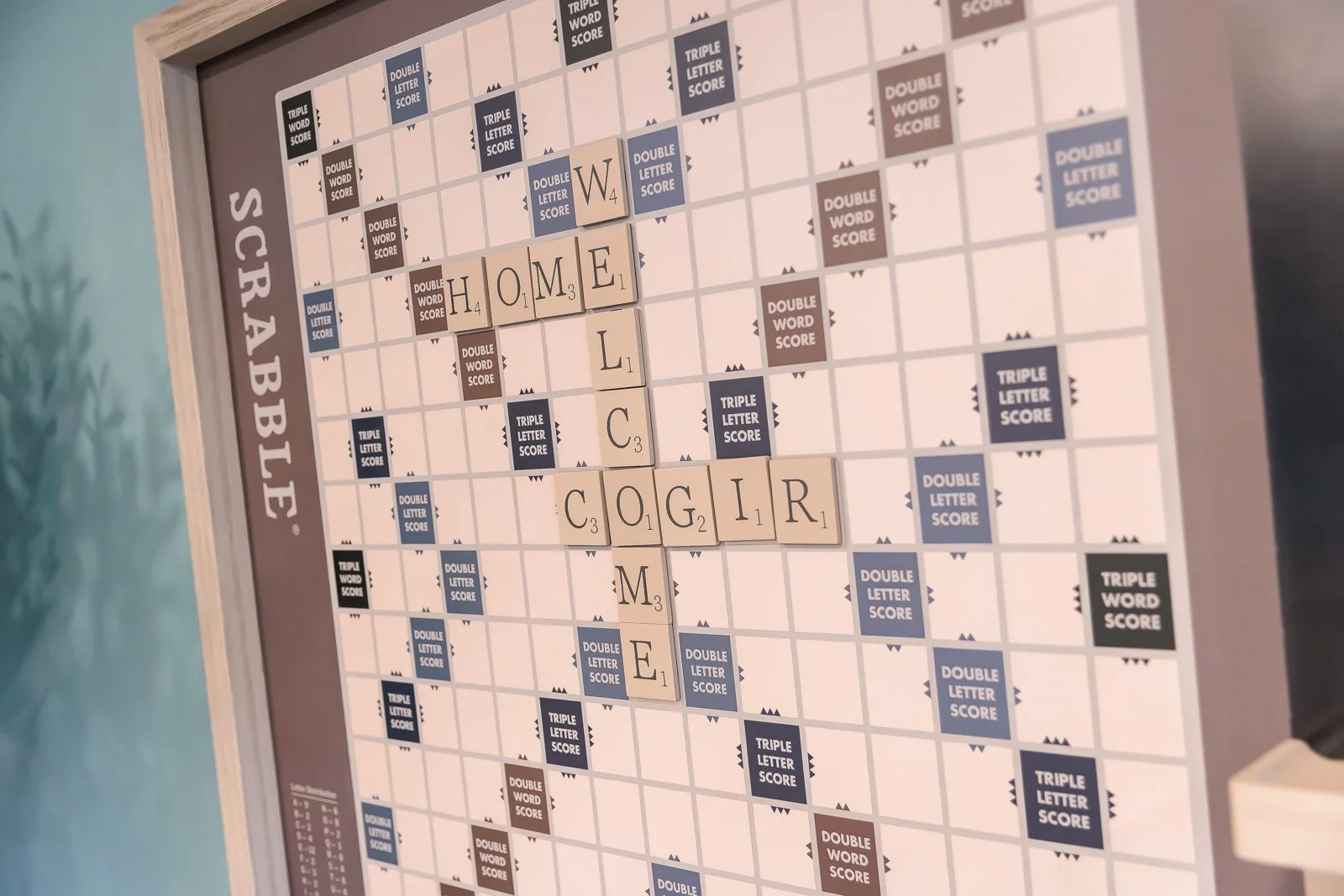
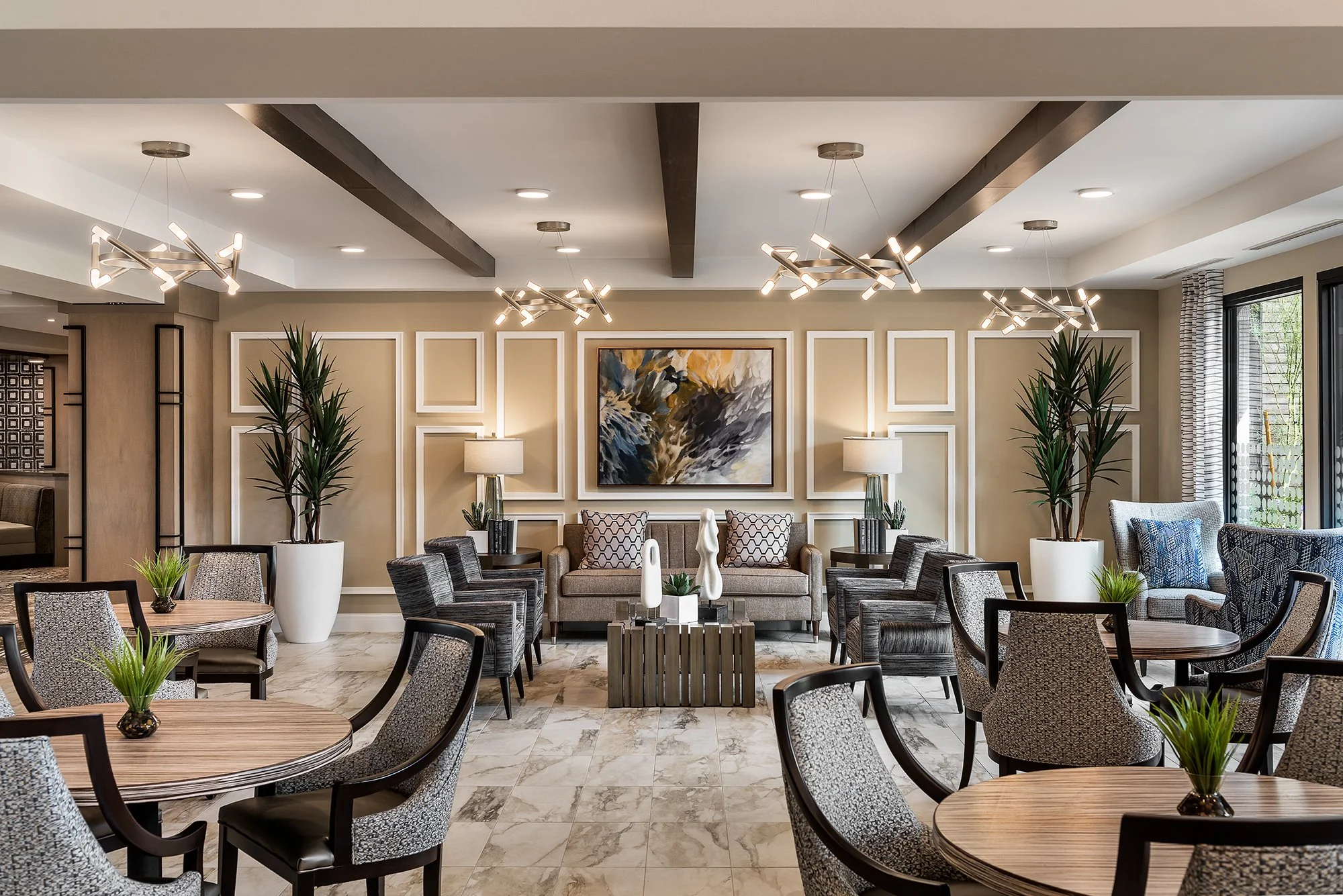
Potential clients aren't just evaluating the physical space — they're reading it for signs of life. Are there real people in the common areas who look happy and engaged? Is there a partially completed puzzle on a table, fresh flowers clearly chosen with care? A calendar on the wall with events that actually look fun? Or does everything feel perfectly staged and slightly hollow?
This is where design and operations really intersect. We design common spaces specifically to invite that kind of authentic, lived-in energy, conversation nooks that are the right size for two people to actually talk, dining areas warm enough to linger in, library spaces cozy enough that you'd actually want to curl up with a book. A beautiful room that nobody wants to be in is a missed opportunity. The spaces we're most proud of are the ones that seem to generate their own life.
4. STAFF BEHAVIOR AS A DESIGN SIGNAL
Here’s one that often surprises our clients: the way staff move through a building is a design signal. When team members appear rushed, are forced to navigate awkward back-of-house shortcuts, or seem clustered away from residents, it’s usually a sign the floor plan isn’t fully supporting them. But when staff are visible, unhurried, and naturally engaged with the people they’re caring for, it reflects a building intentionally designed to foster those relationships.
That’s why we closely study operational workflows through our post-occupancy evaluations of the communities we design. Where do care staff need to be positioned? How can the service side of the building function smoothly without disrupting the residential experience? Where should nursing stations be located so they’re accessible yet unobtrusive? A well-designed community makes all of this feel effortless, and that sense of calm, seamless operation is one of the most powerful impressions a prospective resident or family can experience during a tour.
5. THE CORRIDORS
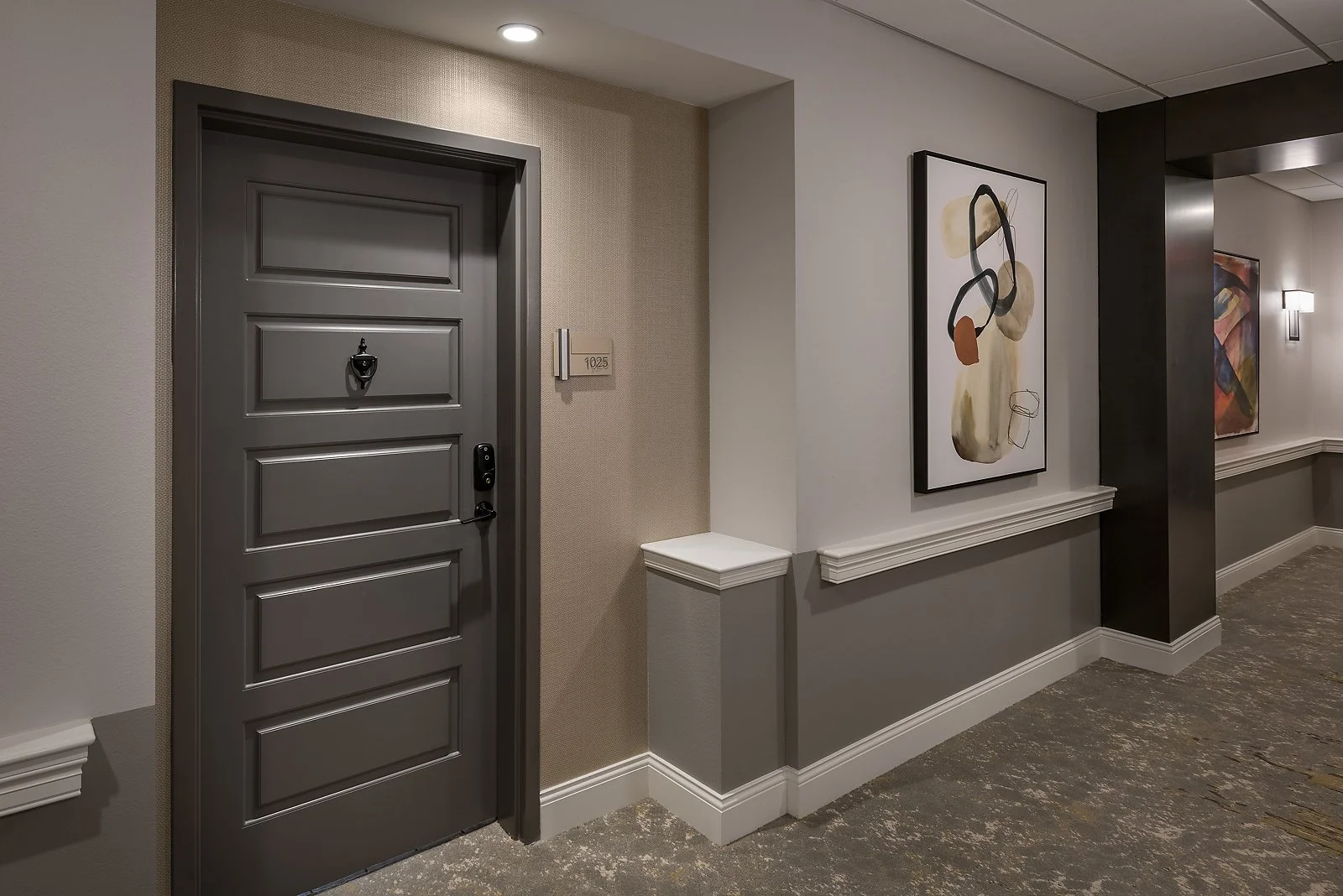
This is where many communities quietly lose tours they thought were going well. Long, undifferentiated corridors with institutional lighting and identical doors will undermine even the most beautiful lobby. The brain pattern matches immediately: this looks like a hospital.
Breaking up the corridor experience is one of our signature design commitments. Alcoves that create moments of visual pause. Artwork programs that tell a story and give residents landmarks in their daily navigation. Lighting that shifts from functional to warm as you move through the building. Material changes that signal you're moving through a neighborhood, not just down a corridor. These details aren't ornamental. They're what carries the emotional momentum of the tour all the way to the front door of the residence
What Prospects Are Really Feeling — Not Thinking
Under all of this, there are three emotional questions running on a loop during any tour. Prospects don't say them out loud, but the answers are shaping everything:
Would I be embarrassed to bring my friends here? Call it the dignity check. Senior living still carries a lot of cultural weight, and people want to feel like this is a choice they made, not a compromise they accepted. Design that feels genuinely elevated, has a point of view and a sense of luxury, that gives them the confidence to say yes.
Does this feel like somewhere someone like me would choose to live? This is about identity. The residents coming into senior living today have incredibly rich lives behind them — they've traveled, collected art, built meaningful careers, developed real taste. The design has to speak to that. It has to say this space was created for someone with your sensibility, at this chapter of your life.
Can I trust the people behind this place to take care of someone I love? This one is the deepest. And design answers it in ways operators sometimes don't realize. A space that's beautifully considered, consistently detailed, and clearly well-maintained signals that the people running this community pay attention. That attention to the physical environment becomes a stand-in for the attention they'll give to care.
The Design Implications — What This Means for Operators and Investors
For the development and operations teams we partner with at Thoma-Holec, understanding this psychological sequence leads to clear strategic decisions:
Every touchpoint in the guest experience deserves intentional design investment, from the entry and lobby, through the corridors, and into the residence itself. The mistake we see most often isn't where money is spent, but when design decisions are made in isolation rather than as part of a connected journey. A stunning lobby followed by an underwhelming unit, or a beautifully appointed residence that a prospect never emotionally commits to because the path there felt institutional — both represent missed opportunities. The strongest communities we've designed treat every phase of the experience as equally load-bearing. Because for the prospect, it all adds up to one feeling.
Treat smell and sound as seriously as visuals. Materials and their acoustic properties, HVAC placement, the presence or absence of ambient sound design — these are invisible to the eye but immediately felt. We pay close attention to acoustic challenges and treat them as part of our design process, because these elements determine whether a space feels warm or clinical.
Design for living, not for photographing. Some spaces look incredible in marketing photos and feel oddly sterile in person. What we're always chasing is the opposite — spaces with layered lighting, materials that invite touch, a sense that real people have been here and want to come back. We call it emotional permission: the feeling that you could actually live here, not just admire it
The front desk is a trust signal, full stop. How the reception area looks and feels tells a prospect exactly what kind of relationship residents have with the people who work here. We put a lot of care into getting that right from scale, warmth, approachability. It sets a tone that echoes through the entire tour.
Bring your interior design team in early — it’s something we believe in strongly. The sooner we’re at the table, the more influence we have on the decisions that truly shape how a building functions as a living environment. From service flows and care station placement to wayfinding and the orientation of common areas that encourage natural use, those foundational choices matter. The work we do later in the process is always stronger when the early, upstream decisions were made with the interior experience in mind — and with us in the room helping guide them.
Design That Converts — Because It Was Built to
At Thoma-Holec Design, we believe the highest compliment a senior living interior can receive isn't from a design publication. It's from a prospect who walks in, looks around, and says: 'I think Mom could be happy here.'
That response isn't accidental. It's the result of understanding the psychology of arrival — and designing every element of the journey to answer the questions prospects are asking before they even know they're asking them.
If you're developing, operating, or investing in senior living communities and want to understand how intentional interior design strategy can shorten lease-up timelines, strengthen your brand, and build lasting resident loyalty, we'd welcome a conversation.