
Active Adult Communities: Where Multifamily Meets Senior Living
As the housing landscape evolves, the lines between Active Adult (AA), Multifamily, and Senior Living communities are becoming increasingly nuanced. For developers and operators, understanding these distinctions is critical—not just from an operational standpoint, but from a design perspective that directly impacts resident experience, market positioning, and long-term success.
At Thoma-Holec Design, we approach each of these sectors with intention. While they may share similarities on the surface, the way they function, and more importantly, how they should feel, requires a deeper level of strategy.
Why This Conversation Matters Now
Over the past decade, Senior Living communities have evolved dramatically away from their clinical, stigmatizing origins. Today, they are among the most amenity-filled, sophisticated, and, at times, luxurious communities available to adults. That shift in perception has opened the door to a new wave of residents, particularly younger aging adults who are now actively welcoming Active Adult communities as a lifestyle choice rather than a last resort. Understanding how these sectors relate to one another is the foundation of designing any of them well.
Active Adult at a Glance: The Market Today
The demand for purpose-built active adult and senior living communities is at an all-time high — and the supply is struggling to keep pace. Here is where the market stands right now:

National occupancy for stabilized active adult communities is 95.7%, with rent growth averaging 4.5% annually over the past 5 years. The sector needs to add over 250,000 units by 2028 to meet demand — and only around 20,000 are currently under construction. This is the environment our clients are building into, and it makes thoughtful, differentiated design more important than ever.
The Core Differences: Function Drives Design
Active Adult (55+): Lifestyle Without Care
Active Adult (55+): Lifestyle Without Healthcare
Active Adult communities are built for a generation that is redefining aging. Today’s residents are active, social, and seeking environments that support independence without the structure of care.
At the core, these communities are about lifestyle, connection, and community, places where residents can easily build relationships, participate in shared experiences, and feel part of something larger than their individual home.
From a design standpoint, this means:
• Hospitality-driven amenity spaces that encourage gathering and interaction
• A strong emphasis on social programming and shared experiences
• Flexible environments that adapt to evolving interests and lifestyles
• Reduced clinical and care-based infrastructure, allowing greater focus on amenities and resident experience
Operationally, AA mirrors multifamily in many ways, lower staffing needs, simplified services, but the intent is entirely different. However, the intent is fundamentally different, these environments are intentionally designed to foster connection, engagement, and an elevated social lifestyle, rather than simply provide housing.
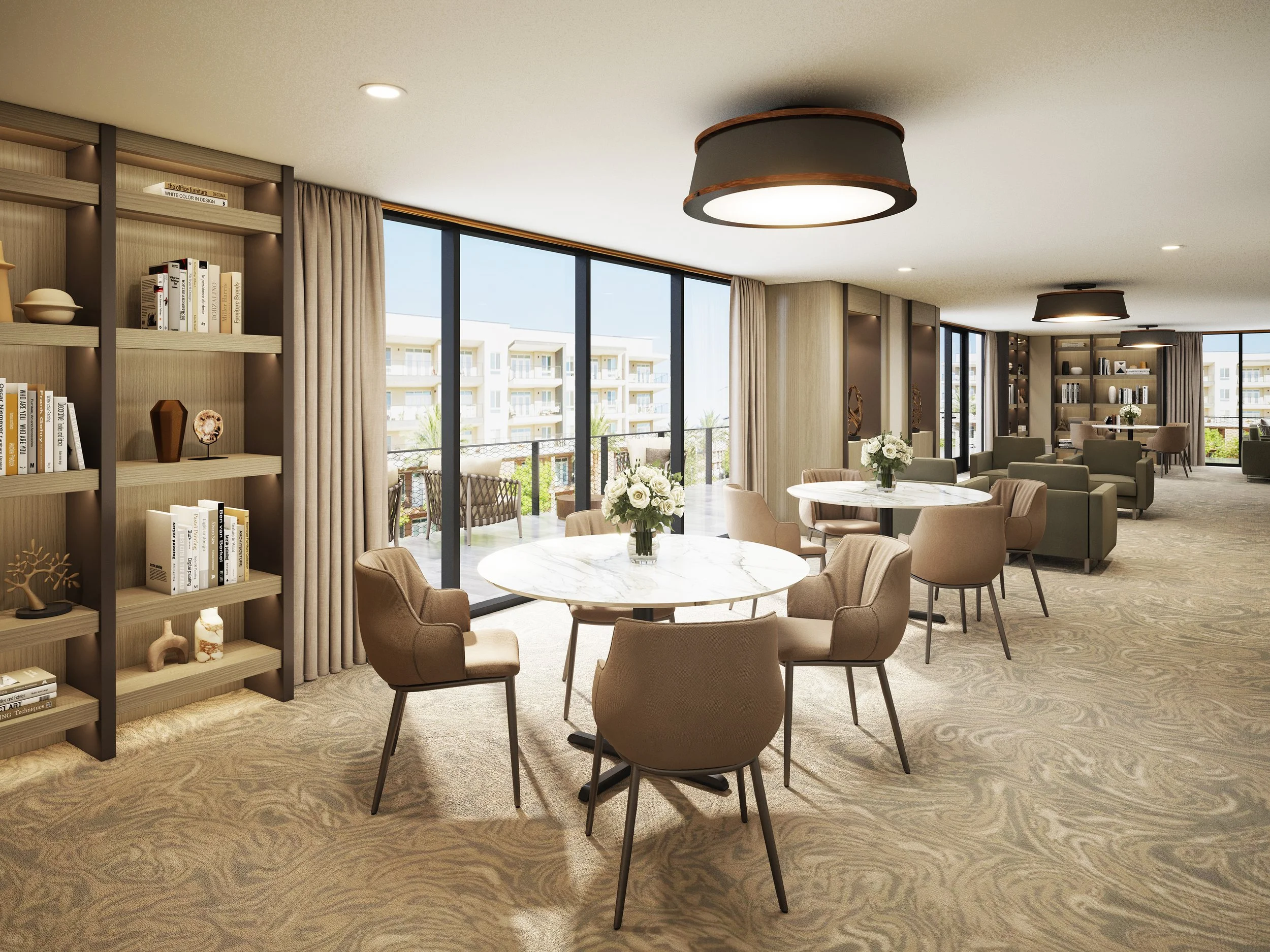
Active Adult Library
Multifamily: Broad Appeal, Individual Focus
Multifamily communities are designed for a wide demographic, often prioritizing efficiency, density, and market-driven amenities.
Design considerations typically include:
· Universal appeal across age groups
· High-impact amenity spaces for competitive positioning
· Efficient unit layouts and scalable solutions
· Less emphasis on curated programming or community-building
While multifamily has begun to incorporate more lifestyle elements, it often lacks the intentional social infrastructure that defines Active Adult and Senior Living environments.
Senior Living: Care, Connection, and Support
Senior Living, whether Independent Living, Assisted Living, or Memory Care, introduces an entirely different layer of care integration.
Design must balance:
Safety, accessibility, and regulatory requirements
Emotional comfort and familiarity and dignity
Clear wayfinding and cognitive support
Spaces that encourage engagement while accommodating varying levels of ability
Here, design is not just about aesthetics or lifestyle, it becomes a critical tool in supporting health, dignity, and daily living.
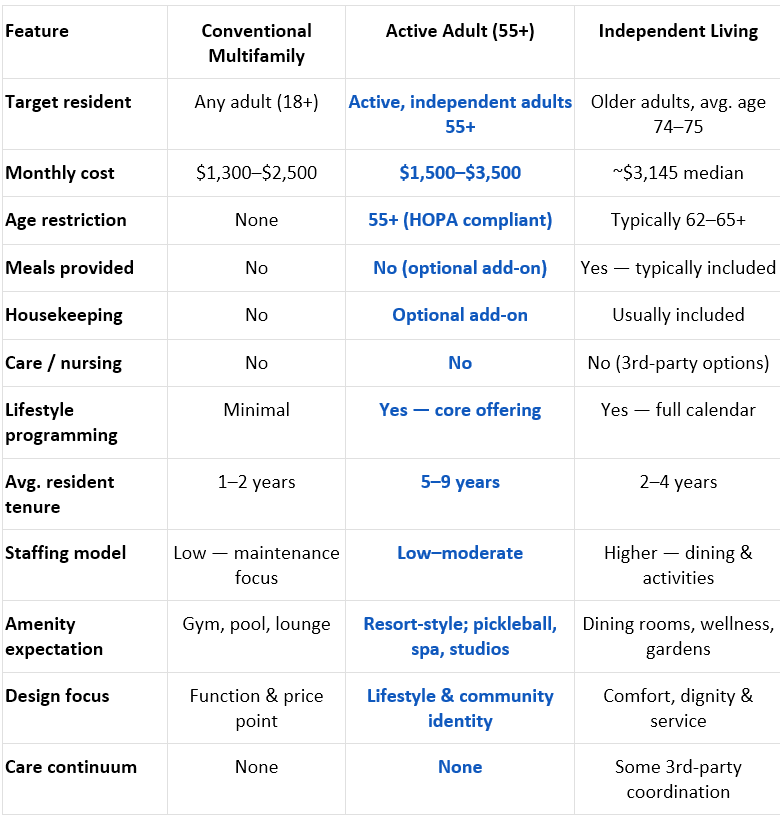
The table below breaks down where these three product types align and where they diverge:
Where They Overlap: The Rise of Experience-Driven Living
Despite their differences, all three sectors are converging in one important way:
Residents expect more than just a place to live, they expect an experience.
Across the board we’re seeing:
Increased focus on wellness and outdoor living
Elevated common areas that foster connection
A move away from institutional or purely functional environments
This is especially true in Active Adult and Senior Living, where social engagement and mental well-being are directly tied to quality of life.

Trending Amenities Across Active Adult & Senior Living (2025–2026)
The amenity bar has risen significantly across both sectors. Here is what residents and the data — are responding to right now:
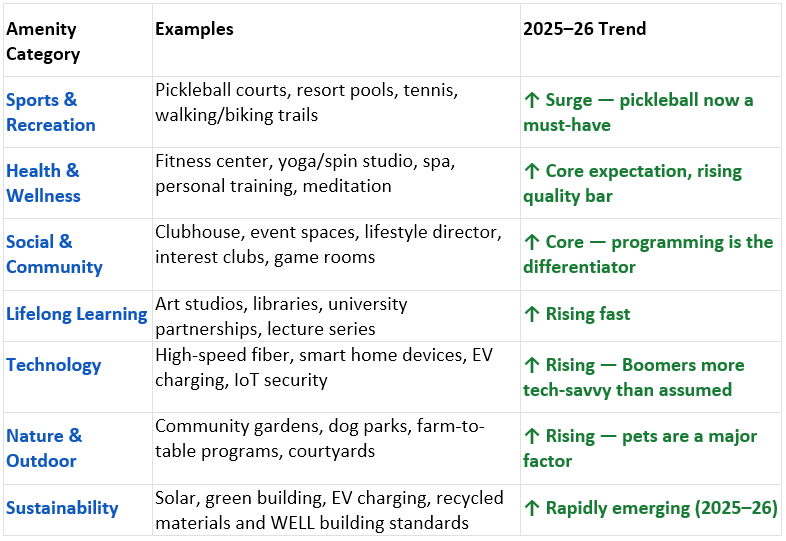
No single amenity trend is more telling right now than the rise of pickleball. From niche sport to non-negotiable community feature, it has become a shorthand for exactly what active adult residents want: an active, social, joy-filled daily life. Communities without it are increasingly at a competitive disadvantage.
THD’s Perspective: Designing With Purpose, Not Assumptions
At THD, we approach Active Adult communities with a clear understanding: this is not downsized senior living—it’s a lifestyle product competing directly with multifamily and for-sale housing.
That distinction drives everything.
Our process begins with the market, not assumptions:
What does “active” actually look like in this region?
Are residents seeking social connection, wellness, or a hospitality-driven experience?
How does this community differentiate itself within its competitive set?
From there, we translate insight into design decisions that shape how the community functions day to day.
Programming-driven space planning
We don’t just design amenity spaces, we design how they will be used throughout the day. Spaces are layered to support both structured events and informal, spontaneous interaction.
Environments with purpose
Rather than overloading communities with amenities, we focus on creating meaningful, high-performing spaces that feel authentic to the brand and location.
Flexibility and longevity
Active Adult residents expect to age in place on their own terms. We design environments that can evolve alongside them without requiring constant reinvestment or repositioning.
A strong sense of identity
Through materials, art, and storytelling, we create communities that feel rooted in their surroundings—helping residents feel a sense of belonging from day one.
Ultimately, our goal is to design environments that naturally foster connection, rather than forcing it.
Where Our Senior Living Expertise Adds Value:
While Active Adult is fundamentally lifestyle-driven, our experience in Senior Living strengthens how we approach it.
We understand how to design for:
• Changing physical and cognitive needs over time
• Intuitive navigation and ease of use
• Long-term durability without sacrificing comfort
This perspective allows us to design Active Adult communities that don’t just meet expectations today, but remain relevant and functional well into the future
Where Design Drives Performance
In Active Adult communities, design isn’t just about aesthetics—it’s a key driver of experience, differentiation, and long-term performance.
For residents, it shapes daily life.
Spaces that are intentionally planned foster natural interaction, support independence, and create a sense of belonging that keeps people engaged and connected.
For families, it builds confidence.
Clear layouts, welcoming environments, and visible activity reinforce that a community is well-run, thoughtful, and aligned with quality of life—not just function.
For owners and operators, it drives results.
Communities that feel relevant to today’s residents lease faster, compete more effectively with multifamily, and sustain occupancy over time. At the same time, thoughtful planning improves operational efficiency and extends the lifecycle of the asset.
At every level, the impact is the same:
when design aligns with how people actually live, it doesn’t just elevate the experience—it strengthens the performance of the entire community.
Designing for What’s Next
The demand for Active Adult and Senior Living communities continues to grow, especially in markets like Arizona, where lifestyle and climate align with resident preferences.
But success in these sectors isn’t just about meeting demand.
It’s about understanding the nuance and designing environments that respond to it.
At THD, we see design as a strategic tool. One that doesn’t just shape spaces—but shapes experiences, outcomes, and ultimately, the success of a community.